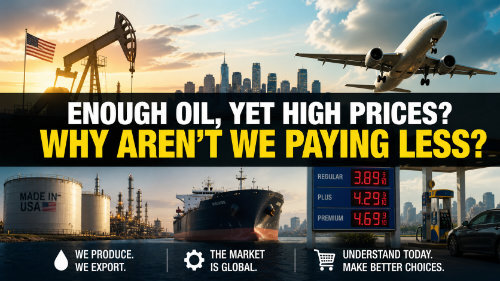
WE MAKE IT. WE SELL IT. SO WHY AREN’T WE PAYING LESS?
Alright, let’s talk about it—because this one’s been bouncing around dinner tables, group chats, and gas stations everywhere. America pumps a ton of oil. We export it. We’ve got the tech, the wells, the muscle. So why does filling up still feel like a mini luxury purchase?
Short answer? Because oil doesn’t care about borders—it cares about the global price tag.
Here’s the deal. Oil is traded worldwide, kind of like gold or coffee. That means the price of a barrel in Texas is heavily influenced by what’s happening across the planet—wars, shipping routes, production cuts, and even rumors. If tensions spike near major shipping lanes like the Strait of Hormuz, prices can jump fast—and yes, that hits your local pump too.
Now here’s the twist that surprises people: we don’t just export—we also import. Why? Because not all oil is the same. U.S. shale oil is lighter, but many of our refineries are built to handle heavier crude from abroad. So while we’re shipping some out, we’re also bringing some in. It’s not a contradiction—it’s a system optimized for efficiency (not simplicity).
Then comes refining—the unsung bottleneck. Gasoline prices aren’t just about crude oil; they’re about how much fuel refineries can actually produce. Limited capacity, maintenance shutdowns, and regulations can tighten supply, pushing prices higher even when oil itself isn’t sky-high.
And let’s be honest: oil companies are in business to make money. If global buyers are willing to pay more, that’s where the oil goes. Keeping everything “cheap at home” would mean stepping in hard—think export limits or price controls—which can backfire by reducing production or creating shortages down the line.
Add in taxes, transportation, and local rules (hello, California), and suddenly that price per gallon starts to make more sense—even if it still stings.
So what’s the takeaway? America’s energy game is strong, no doubt. But we’re playing in a global arena, not a backyard sandbox. Being a top producer gives us leverage—not immunity.
It’s not as simple as “we have it, so it should be cheap.” It’s more like: we have it, we sell it, and the world helps set the price.
And once you see that? The numbers at the pump don’t feel random anymore—they feel… connected.
 News Staff
 -
-
Business
America First-Energy
US-largest-oil-producers
high-prizes
-
697 views -
0 Comments -
0 Likes -
0 Reviews
-
-
Business
America First-Energy
US-largest-oil-producers
high-prizes
-
697 views -
0 Comments -
0 Likes -
0 Reviews