Up to 200,000 U.S. Visas Face Revocation
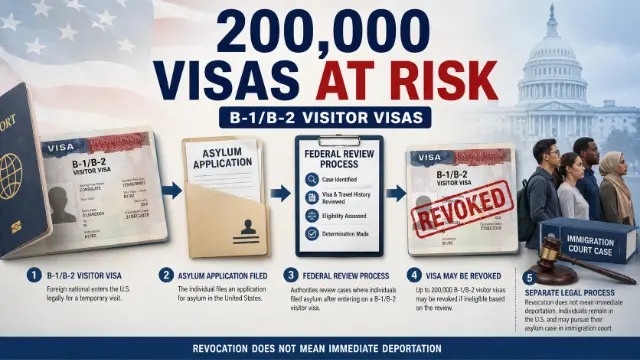
The Trump administration is preparing to revoke the business and tourist visas of as many as 200,000 foreign nationals who entered the United States as temporary visitors and later applied for asylum.
If fully implemented, the action would represent the largest coordinated mass visa revocation in U.S. history. However, the 200,000 figure is an upper estimate—not a confirmed number of visas already canceled.
The government is reviewing B-1 business visas and B-2 tourist visas issued between 2016 and 2026. The State Department is working with the Department of Homeland Security to identify visa holders who subsequently submitted asylum applications.
“We are coordinating with DHS to identify and revoke the nonimmigrant visas of foreigners who have come to the United States claiming to be short-term visitors, but then file for asylum to stay here permanently,” State Department spokesman Tommy Pigott said.
Pigott declined to confirm how many people would ultimately be affected. He said the total remained “dynamic” and that revocations would occur gradually.
The administration argues that applying for asylum after entering as a temporary visitor may indicate that the traveler misrepresented an intention to return home. Deputy Secretary of State Christopher Landau accused some applicants of using asylum as a loophole to remain in the country while their cases move through an overloaded system.
However, an asylum application filed after entering on a visitor visa is not automatically fraudulent. Federal law generally allows foreign nationals who are physically present in the United States to seek asylum regardless of their immigration status, subject to filing deadlines and other eligibility restrictions. Applicants must still establish persecution or a well-founded fear of persecution because of race, religion, nationality, political opinion or membership in a particular social group.
Revoking a visa also does not automatically result in immediate deportation or cancel an asylum application. A visa is primarily a travel document permitting a person to request entry at a U.S. port. It is legally separate from the period of stay authorized by immigration officials after admission.
For people already inside the United States, revocation generally prevents them from using that visa to return after traveling abroad. Their continued ability to remain in the country would depend on their authorized stay, pending asylum proceedings, any other immigration protection and subsequent action by DHS or an immigration court. A pending asylum application, by itself, does not necessarily create lawful immigration status.
The initiative is part of a wider immigration crackdown during President Trump’s second term. The State Department says it has revoked approximately 175,000 visas during the past 18 months for reasons including criminal allegations, criminal convictions and conduct the administration considers contrary to U.S. foreign-policy or national-security interests.
The government has also changed asylum procedures. A rule that took effect July 28 allows U.S. Citizenship and Immigration Services officers to refer certain applicants directly to immigration court without first conducting the traditional asylum interview. Immigration-rights organizations have sued to block that rule, arguing that it denies applicants a meaningful opportunity to explain their claims.
The planned visa cancellations may face similar legal challenges. Until the government completes its review, the exact number of affected people—and how aggressively DHS will pursue their removal—remains uncertain.
 News Staff
 -
-
Business
B-1 business visas and B-2 tourist visas issued between 2016 and 2026
-
340 views -
0 Comments -
0 Likes -
0 Reviews
-
-
Business
B-1 business visas and B-2 tourist visas issued between 2016 and 2026
-
340 views -
0 Comments -
0 Likes -
0 Reviews