The Second Coming… With a Second Opinion
In the grand, unpredictable theater of American politics, Donald Trump has once again delivered a moment that feels equal parts headline and parable—this time starring himself in an image that many interpreted as, well, biblical.
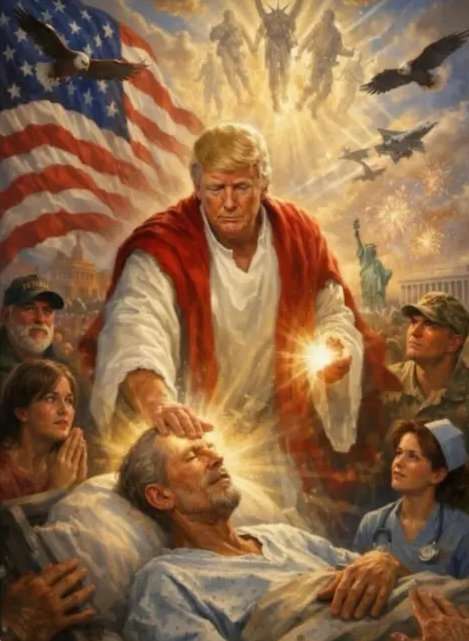
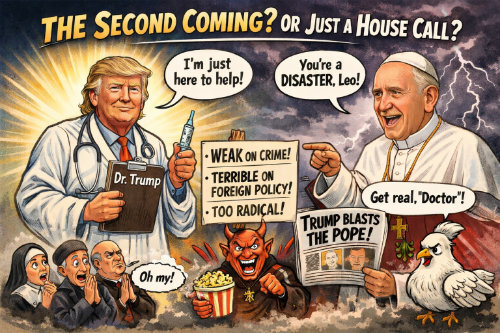
The now-viral post depicted Trump in unmistakably Jesus-like form: flowing robes, a soft glow, and a pose that seemed ready for stained glass. Within minutes, the internet did what it does best—react. Some supporters leaned into the symbolism, calling it powerful, even poetic. Others, including religious leaders and everyday churchgoers, were less inclined to see the humor, questioning why sacred imagery was being repurposed for political flair.
And then came the twist.
Trump, never one to leave a narrative unedited, clarified that the image wasn’t meant to portray him as a messianic figure at all. No, he said—it was supposed to depict him as a doctor.
A doctor.
Not the Second Coming, but perhaps a second opinion.
If that explanation felt like a sharp left turn, the timing made it even more curious. Because just as the image sparked theological side-eyes, Trump was also engaged in a very earthly dispute—with Pope Leo.
Late Sunday, Trump took to social media with a blistering critique of the pope’s comments on the Iran conflict. In a post that read more like a campaign rally than a Sunday reflection, Trump called the pontiff “WEAK on Crime, and terrible for Foreign Policy,” suggesting Pope Leo had been chosen “because he was an American” to better deal with him. He urged the pope to “get his act together,” stop “catering to the Radical Left,” and warned that his leadership was hurting the Catholic Church.
For observers, the overlap was hard to ignore: a Jesus-like image on one hand, a public feud with the leader of the Catholic Church on the other. Coincidence? Strategy? Or simply another chapter in a political style that thrives on provocation and spectacle?
There’s a certain irony in the sequence. While clergy and faithful wrestled with the meaning of the image, the man at the center of it all dismissed the divine comparison and pivoted to something far more clinical—casting himself not as a savior, but as a fixer. Meanwhile, his sharp words for the pope suggested little appetite for ecclesiastical guidance.
So what does it mean?
Perhaps nothing more—and nothing less—than a reminder of how modern politics operates: symbolism deployed at full volume, interpretation left to the audience, and controversy arriving right on cue. In this case, the visuals suggested heaven, the explanation suggested a house call, and the commentary landed squarely on earth.
Doctor, critic, or accidental icon—whatever the role, the timing ensures one thing: people aren’t just watching the message anymore. They’re reading between the lines.
 News Staff
 -
-
Arts & Culture
President Trump
Pope Leo
-
793 views -
0 Comments -
0 Likes -
0 Reviews
-
-
Arts & Culture
President Trump
Pope Leo
-
793 views -
0 Comments -
0 Likes -
0 Reviews