Passport to Power—or Ego? Trump’s Face Finds a New Page in America’s Story
Washington — In a twist that feels equal parts statecraft and stagecraft, a newly announced “limited edition” U.S. passport tied to the nation’s 250th anniversary has ignited a fresh round of debate—this time over whether patriotism now comes with a portrait.
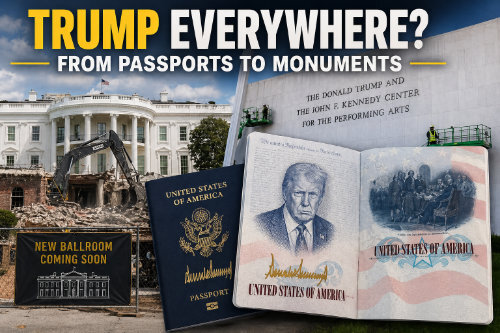
According to circulating reports, the commemorative passport edition features the likeness and signature of Donald Trump prominently displayed on an interior page, layered above imagery inspired by the Declaration of Independence. If accurate, it would mark an unprecedented visual inclusion of a sitting president within a U.S. passport design—historically a document rooted in national symbols, not individual leaders.
No official government confirmation has detailed full distribution, scope, or availability of such passports nationwide, leaving questions about whether this is a symbolic release, a limited collector’s item, or something more experimental. What is clear, however, is that the conversation it sparked is very real.
Because the passport, critics say, is just the latest chapter in a much longer story: the evolution of Trump from politician into full-spectrum brand.
From real estate towers to digital platforms like Truth Social, Trump has long blurred the lines between personal identity and public presence. Supporters argue that this is simply modern leadership—direct, recognizable, and unapologetically personal. Detractors see something else: the steady expansion of one man’s image into spaces traditionally reserved for shared national identity.
Even cultural institutions have not escaped the gravitational pull. The renaming of the John F. Kennedy Center for the Performing Arts—following leadership changes approved by its governing board—has been cited by critics as another example of legacy-building through institutional influence, though the move remains politically and culturally contested.
Add to that ongoing discussions around White House renovations, including proposals for a new ballroom, and a broader narrative begins to take shape—one where architecture, branding, and governance intersect in unusual ways.
Satire, of course, writes itself.
In this imagined “Trump Edition” America, historians may one day flip through official documents not just to trace the evolution of a nation, but to count how many times one name appears along the way. Passport stamps might one day compete with signatures. Monuments may double as logos. And somewhere between the ink and the paper, the quiet question lingers:
At what point does legacy become labeling?
For now, the passport—real, rumored, or somewhere in between—has done exactly what modern political artifacts are designed to do: start a conversation. Whether it’s about pride, power, or personal imprint depends largely on who’s holding the document—and how closely they’re reading the fine print.
 News Staff
 -
-
Business
Trump Brand Everywhere
US Passport
-
885 views -
0 Comments -
0 Likes -
0 Reviews
-
-
Business
Trump Brand Everywhere
US Passport
-
885 views -
0 Comments -
0 Likes -
0 Reviews